
Joy as an Act of Resistance
THE SOIL BENEATH THE WEATHER
by Leo Moraes and Dru Lojero.
Why joy endures where happiness cannot
This week, we are enthralled by the idea of joy as an act of resistance. Not to be confused with happiness—which can only exist in acceptance—joy is something deeper. Something we can cultivate, share, and carry with us even when the world gets heavy.
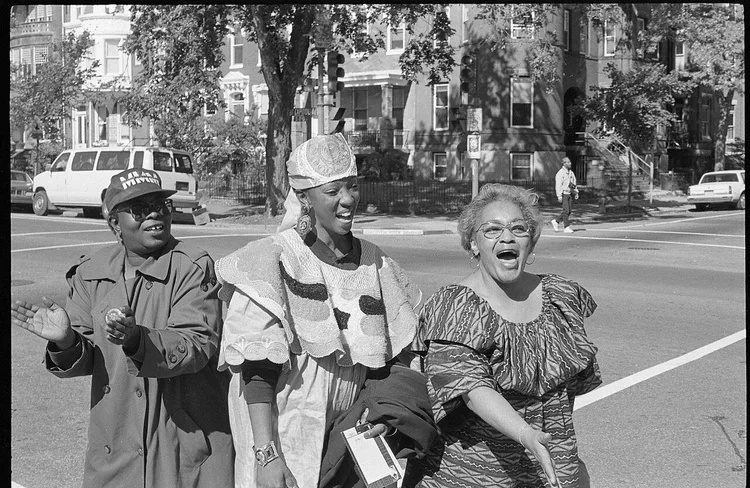
Women singing in DC on the day of The Million Man March. Photo by Duncan Spencer
Happiness is an emotion. It is fleeting by nature, a biochemical response to something external. You feel happy when you get the promotion, when the meal is delicious, when the sun breaks through the clouds, when your friends surround you. Happiness depends on circumstances. This is not a flaw; it is simply what emotions do. Like weather, they arrive and they leave.
Joy is a state of being. It is deeper, more stable, less dependent on outcomes going your way. Joy is the soil beneath the weather, present every day, regardless of the forecast. It is the sense of meaning, purpose, and connection that anchors us even when the storm rolls in. Joy does not ask that life be easy. It asks that life be meaningful.
You can be in a state of joy and still feel profound sadness. A parent holding a sick child. A community mourning a loss while gathered together. An artist working in poverty, driven by something that will not let them go. The sorrow is real. The joy is also real. They coexist because joy is not the absence of pain: it is the presence of something underneath it.
Here is the trap we often fall into: we chase happiness as if it were the ultimate prize, mistaking it for the thing that will make us whole. We think: if I get that job, that relationship, that record, that ticket to that show, then I will be okay. But happiness, being an emotion, is not built to last. It comes and goes. And when it goes, we are left wondering what we did wrong.

During carnaval festivities in Rio, flags with murdered politician Marielle Franco
And here is the beautiful thing: while happiness is largely an internal experience—a feeling that arises in response to what happens to us—joy is something we can give each other. It's contagious.
No one can make you happy. Not really. Happiness is too contingent, too personal, too tied to the ever-shifting landscape of your own circumstance(s). But you can bring someone joy. Joy shines like a light in darkness.
Because joy is what endures. Joy is what we cultivate internally, through gratitude, through meaning, through alignment with what we value. Joy is not handed to us by circumstances. It is built, slowly, in the choices we make about how to live.
This is why, in the most unlikely places on earth—places marked by poverty, by occupation, by the slow erosion of hope—you find bursts of joy, with music always at the front.
From Cuba to Lebanon. From Skid Row to Trenchtown. From Rocinha to the Bronx. From New Orleans to Lagos.
It is not a coincidence that the most universal music styles—jazz, Afrobeat, blues, reggae, hip-hop, samba, to name a few—were not born in palaces. They were born in the margins. In the places where joy is most desperately needed. In communities that learned, out of necessity, to cultivate something that circumstances could not take away.

Because when the world is heavy, you do not wait for happiness to arrive. You gather. You play. You dance. You dream. Ultimately, you find hope. You remind each other that sorrow is not the final word—that beneath the weather, the ground still holds. It’s through this process that joy is found, mined through your chest plate. It’s this act of resistance that gives us the strength to not only survive but break through. Happiness is found and made in your brain while joy exists in your heart.
So let this be our reminder. Let's remember why we're here. Not just as fans of music, but as participants in something older and deeper than any genre. We are here to give what we can to our neighbors—to the person next to us in the crowd, to the musician on stage giving everything they have, to the community that holds us.
We all have more power to affect the world than we think. We are not powerless. The very process of resistance builds into the joy that sustains us.
And in times of sorrow—because there will be sorrow—bringing joy might be the most powerful gift we can offer. Not as a distraction from the hard work of finding meaning, but as the very substance of it.
So go to the show, sing your favorite songs, wear your favorite artists shirt, put up the poster that brings life colors to your room, dance in shower. Let the joy flow through your from the well of your spirit. And when it does, pass it on.