
The Dancefloor as a Political Space
“Until the philosophy which hold one race superior and another inferior is finally and permanently discredited and abandoned... everywhere is war.”
This week, we’re tracing the low end of liberation, exploring how the dancefloor has always been a battleground for the right to exist and resist. As the revolutionary sounds of Adrian Younge sweep across Europe on his latest tour, we’re reminded that the pulse of change is a constant. From the foundational work of Jazz Is Dead in reclaiming legacy, to the future-forward ethos of Linear Labs, the message is clear: the groove is a manifesto, and the party is political.
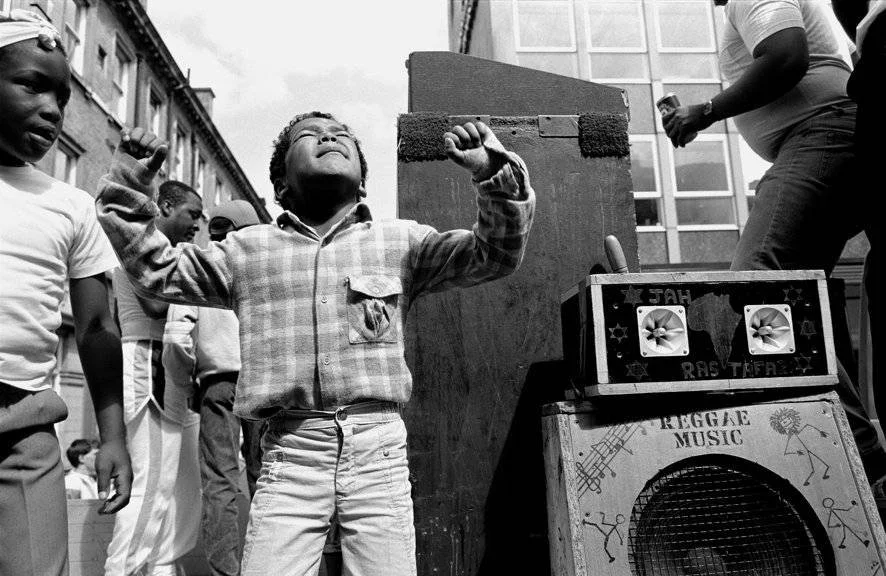
Huddersfield Carnival, UK, August 1987 - Photo by Tim Smith
We often think of protest as a march, a raised fist, a shouted slogan. But sometimes, the most potent act of resistance is a beat, a body in motion, a collective sweat under a strobe light. Long before it was a sound, revolution was a rhythm. From the plantations to the favelas, the history of the dancefloor is a history of carving out freedom in a world that seeks to deny it. It is a space where the marginalized don't just escape the world, but build a new one, if only for the night.
This isn't just theory. It's a reality forged under threat.
In the favelas of Rio de Janeiro, the Baile Funk is more than a party; it's a sonic occupation. Born from the Black and poor peripheries, its thunderous beats and rapid-fire lyrics narrate a reality of police violence, economic struggle, and social resistance that the powerful would rather ignore. And for that, the bailes have been systematically targeted—raided, shut down, and criminalized by authorities who fear the power of a thousand bodies moving in sync to a rhythm they cannot control. The repression isn't about noise; it's about a culture that asserts its right to exist, celebrate, and speak its truth loudly and unapologetically in a society that wishes it would be silent.
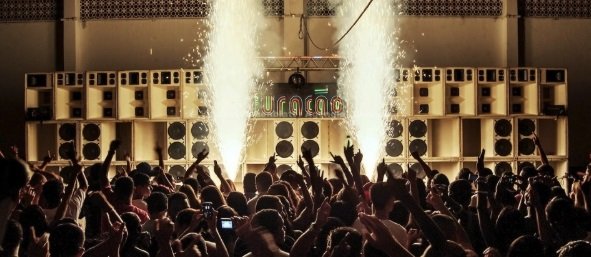
A “Baile Funk”, in Rio
This pattern of repression is a tragic constant in the African diaspora.
Look to the Harlem Renaissance of the 1920s, where the rent parties and jazz clubs were not just venues for entertainment, but crucial ecosystems for Black economic autonomy and artistic expression in a segregated America. The music was the heartbeat of the "New Negro" movement, a declaration of identity and intellect that defied racist caricatures.
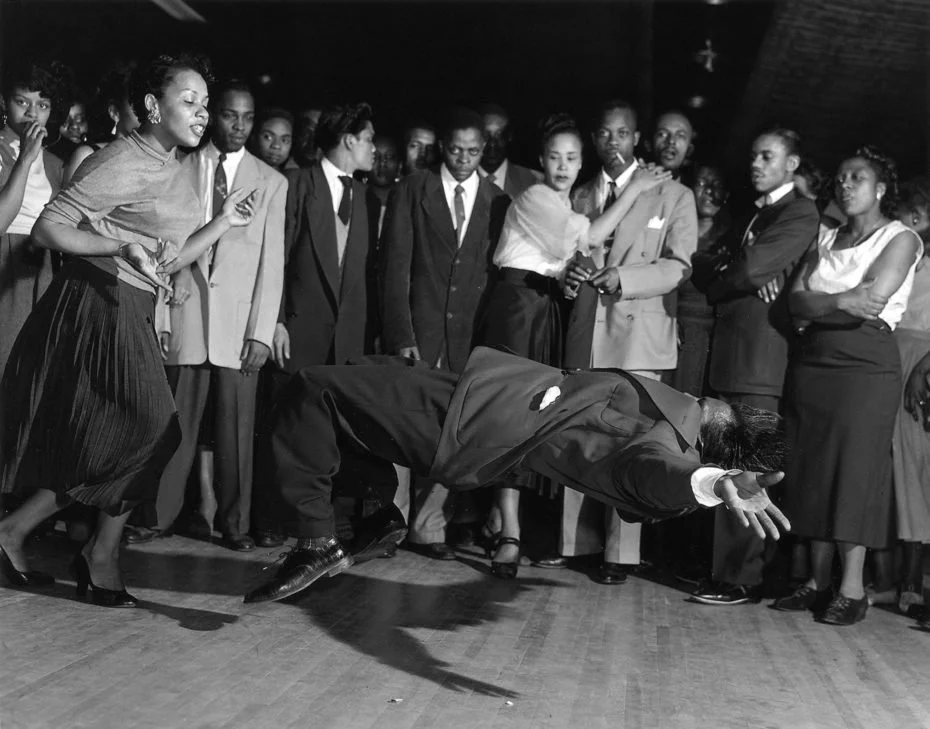
Lee Moates and Tonita Malau, Harlem, 1953 - Photo by Hans von Nolde
Cross the Atlantic to the UK in the 80s and 90s, where Sound System Culture—rooted in the Jamaican tradition—provided a sanctuary for Black and working-class youth. In the face of Thatcherism, institutional racism, and police harassment (notably through laws like the 1994 Criminal Justice and Public Order Act, which specifically targeted raves), these gatherings were acts of defiance. The sheer physical power of the bass was a felt frequency of community and resilience.
The dancefloor, in these contexts, is not an escape. It is a rehearsal. It is a space where community is forged, where identity is strengthened, and where the very act of joy becomes a radical statement against a system that seeks to criminalize Black and Brown bodies, whether they are in motion or at rest. To party on your own terms, in your own sound, is to claim sovereignty over your own body and your own culture.
This weekend, and every weekend, this legacy continues. It lives in the DJ collectives throwing parties for their own communities, in the underground spots prioritizing the safety and freedom of their patrons, and in the beats that carry the coded histories of resistance.
Seek out these spaces. Support them. Understand that when you step onto that floor, you are not just moving to a rhythm. You are stepping into a history. You are participating in a fight for the right to simply be.